

And introducing the players. 456 for an instant win. 123 for an automatic loss. 6
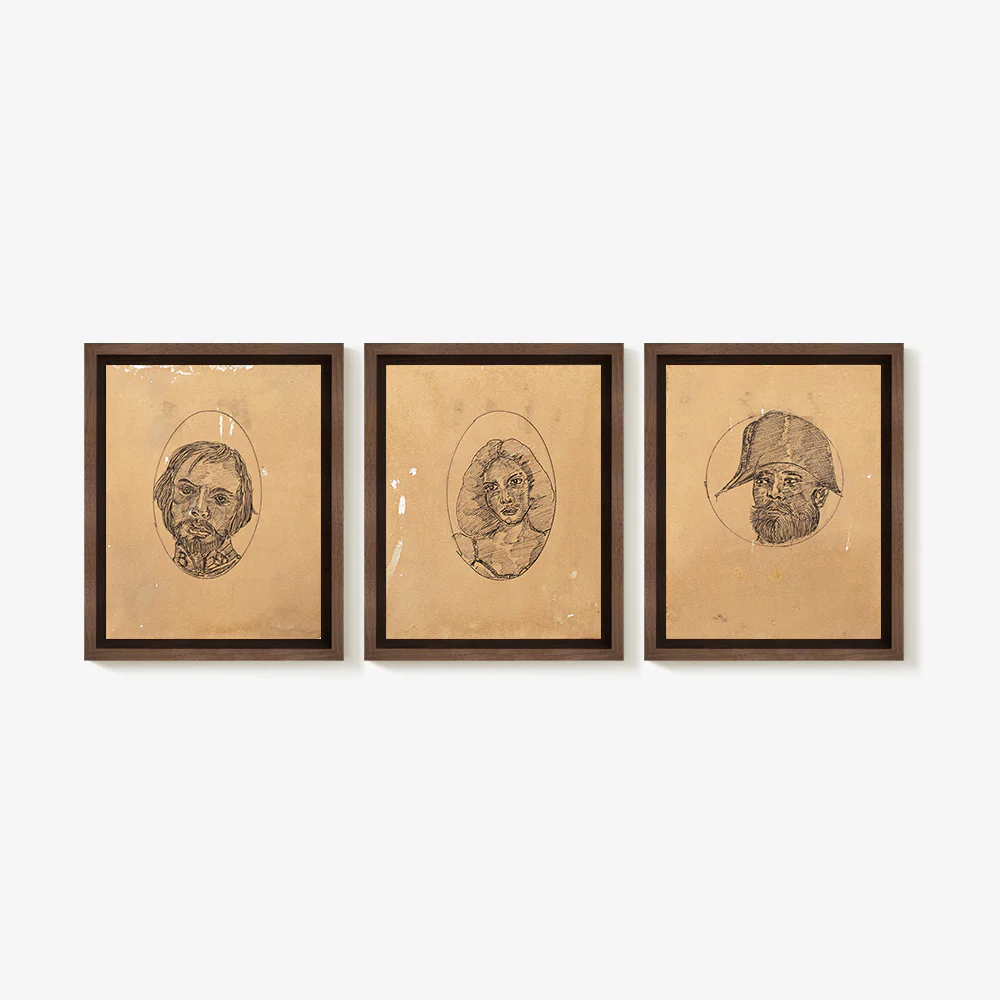
Umar Rashid’s portraits fold history in on itself, merging centuries into a single, continuous narrative. Each triptych depicts three of the artist’s friends, yet the figures seem to exist across multiple timelines.
Some appear in contemporary clothing while others wear historic attire, collapsing any clear sense of time and prompting the viewer to question whether time and progress are truly linear. Are these figures part of our world, or do they belong to Rashid’s alternate history, the Frenglish Empire? They seem to exist in a space where past and present exist side by side in perpetual conversation.
The result is a body of work that asks the viewer to consider not just who these people are, but when they are—to question whether we are seeing them in our own timeline or within Rashid’s ever-unfolding account of empire, resistance, and survival. At the same time, it reminds us that the figures who populate history’s grand narratives are also individuals—friends, fragile and specific as well as heroic and monumental.
Original: $3,600.00
-70%$3,600.00
$1,080.00Product Information
Product Information
Shipping & Returns
Shipping & Returns
Description
Umar Rashid’s portraits fold history in on itself, merging centuries into a single, continuous narrative. Each triptych depicts three of the artist’s friends, yet the figures seem to exist across multiple timelines.
Some appear in contemporary clothing while others wear historic attire, collapsing any clear sense of time and prompting the viewer to question whether time and progress are truly linear. Are these figures part of our world, or do they belong to Rashid’s alternate history, the Frenglish Empire? They seem to exist in a space where past and present exist side by side in perpetual conversation.
The result is a body of work that asks the viewer to consider not just who these people are, but when they are—to question whether we are seeing them in our own timeline or within Rashid’s ever-unfolding account of empire, resistance, and survival. At the same time, it reminds us that the figures who populate history’s grand narratives are also individuals—friends, fragile and specific as well as heroic and monumental.